- Resources
- Berlin’s reuse pilot shows a clear business case for circular packaging
Resources
Berlin’s reuse pilot shows a clear business case for circular packaging
Published: January 15, 2026 by Thorfinn Stainforth
Sustainable packaging innovation and reuse models are a growing business opportunity. Consumer expectations are rising, with more buyers factoring packaging sustainability into their purchasing decisions, while governments face increasing pressure to address packaging waste—estimated to make up roughly one-third of landfill volume across the U.S. and Europe. Together, these forces are pushing companies to rethink packaging design, materials, and systems to meet evolving market and regulatory demands.
Across Europe, companies are under mounting pressure to reduce waste, cut costs and prepare for tighter packaging rules. Yet one question continues to surface in boardrooms: Can reuse systems work at scale without disrupting business?
A new pilot in Berlin provides one of the clearest answers so far: yes. And not as a future ambition, but as a commercially viable model operating in real conditions today.
A reuse system built for business reality
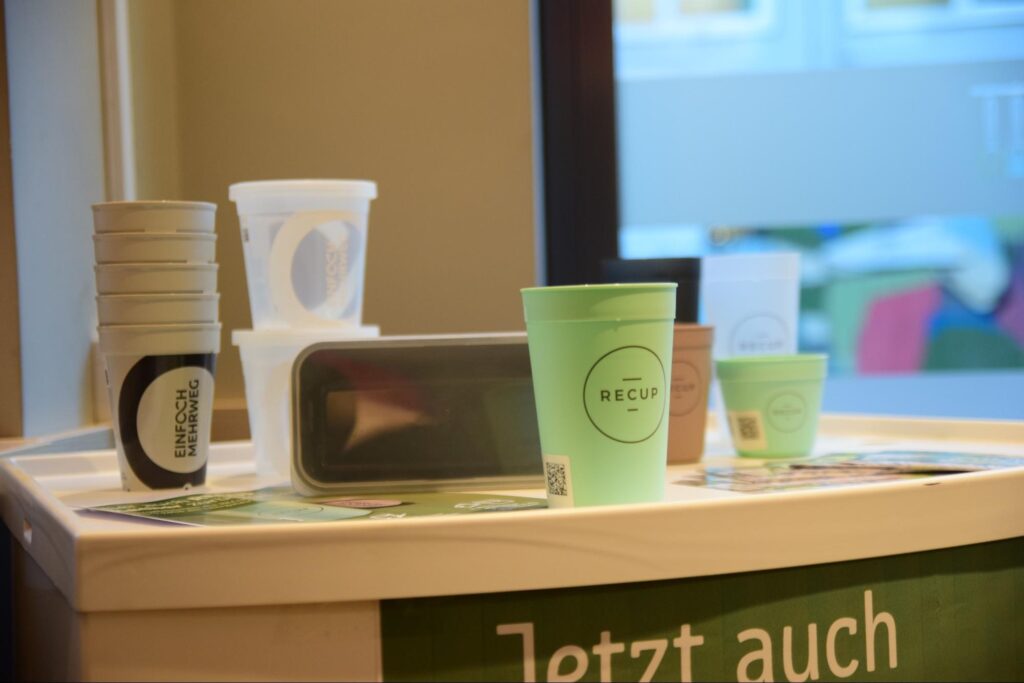
The Berlin project builds on ReCup’s established reusable cup network, which allows customers to borrow a durable cup and return it across a wide network of cafés and drop-off points. The system is designed for speed and convenience, the two factors that determine whether a customer will adopt a new behaviour.
For businesses, this matters. A reuse solution only succeeds when it is both effortless for customers and operationally simple for staff. Key findings included:
- Fast customer adoption when return points are widespread
- Minimal workflow disruption for cafés
- Lower long-term packaging costs compared with single-use
- Reduced waste volumes, easing in-store waste handling
- Brand alignment with sustainability expectations from consumers and employees
In a sector where margins are tight and speed matters, these small efficiencies create meaningful advantages.
Performance proven under real-world conditions
Durability and functionality are non-negotiable for any high-volume reuse system. The Berlin pilot confirmed that the cups:
- Withstand repeated use without degrading
- Are safe for hot beverages
- Stack, store, and transport easily
- Fit smoothly into existing storage and wash cycles
These practical considerations determine whether reuse can work day-to-day at scale – and in Berlin, they did.
Why this is relevant for companies across Europe
Although the pilot focuses on coffee cups, the implications extend far beyond beverages. The Berlin model offers a blueprint for how reuse can help companies respond to emerging pressures across multiple sectors:
- Staying ahead of regulation
Europe’s accelerating shift toward a circular economy means tighter rules on single-use packaging under the Circular Economy and Packaging and Packaging Waste Regulation agenda are coming soon. Early adopters reduce future compliance costs and avoid rushed, disruptive transitions later. - Reducing long-term operating costs
Single-use packaging is a recurring expense. Reuse turns packaging into an asset – one that becomes more cost-effective with each cycle. - Strengthening the customer experience
When reuse is convenient, attractive and easy to use, it becomes part of the brand experience, not a barrier. - De-risking supply chains
Reusable assets reduce dependence on volatile commodity markets and shortages that affect single-use materials. - Demonstrating leadership in sustainability
Customers, investors and employees increasingly expect concrete, credible action on circularity. Reuse delivers a tangible proof point.
Reuse is now a competitive strategy
For years, reusable packaging was seen as a niche sustainability initiative. The Berlin pilot shows that it can be a practical business strategy that reduces costs, meets regulatory expectations and improves customer engagement.
As Europe’s shift toward circularity is accelerating, companies that integrate reuse early will be in a stronger position than those who wait until compliance becomes mandatory.
Berlin’s experience offers a clear message to business: Reuse works. It scales. And it delivers value.