- Resources
- Bridging sustainability and government affairs: A practical playbook for alignment (and impact)
Resources
Bridging sustainability and government affairs: A practical playbook for alignment (and impact)
Published: May 14, 2026 by Daniel Neff
At DC Climate Week, EDF’s Net Zero Action Accelerator and Pure Strategies convened corporate Sustainability and Government Affairs leaders to surface where misalignment shows up in their respective work—and what it takes to find common ground across strategy themes like energy, AI & data centers, disclosure, nature & biodiversity, trade, and supply chains.
A key organizational solution could help companies better deliver on climate goals and consumer demand.
Across industries, companies are facing a rapidly shifting climate landscape, with new disclosure expectations, uprooted trade dynamics, and evolving standards that can materially affect cost, competitiveness, and market access. Yet inside many organizations, the teams best positioned to shape an effective response—Sustainability and Government Affairs—often operate on parallel tracks. This misalignment can result in mixed signals to external stakeholders, missed opportunities to engage early, and avoidable friction when policy decisions collide with corporate climate commitments.
Misalignment is rarely about intent. Sustainability teams may be focused on long-term targets, customer expectations, and investor pressure; Government Affairs teams may be optimized for near-term legislative and regulatory outcomes, coalition management, and political risk reduction. Without shared decision-making, organizations can end up with:
- Reactive policy engagement—showing up late after key design choices are already set.
- Disjointed strategy when trade, permitting, or sector rules impact the feasibility or cost of decarbonization plans.
- Lack of clarity over cross-cutting topics like supply-chain emissions, product standards, and climate-related trade policy.
This misalignment could cost companies valuable opportunities to maximize positive climate outcomes and communicate climate leadership with consumers. A recent analysis published in Harvard Business Review revealed that sustainably marketed products sold 13-14% better than default products. However, with increased regulatory scrutiny, companies should only market these claims if they are backed with integrity. A new organizational approach could help companies bridge this gap.
How to assess this strategic partnership within your company
Strategic Partnership Matrix
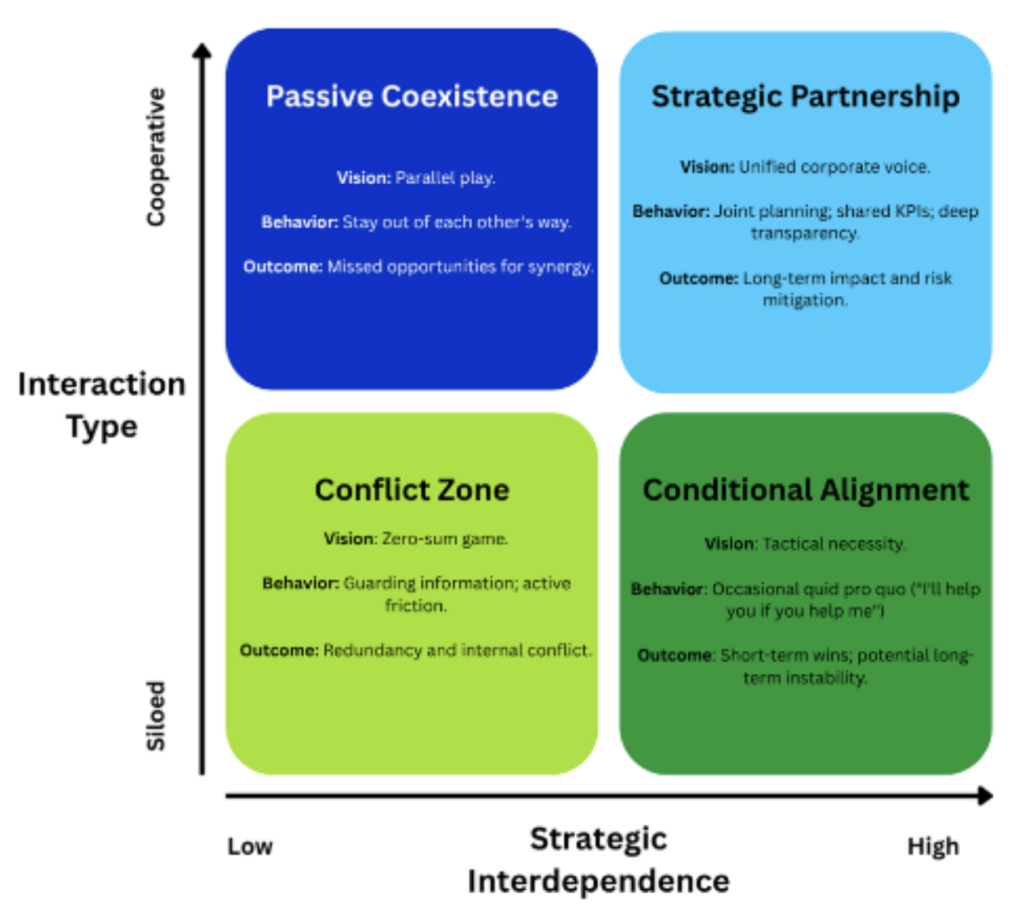
EDF and Pure Strategies developed a useful diagnostic tool to help companies assess where their teams currently meet. This Strategic Partnership Matrix plots the relationship between Sustainability and Government Affairs along two dimensions: how teams interact (cooperative vs. siloed) and how much their strategic agendas depend on each other (low vs. high interdependence). The four resulting quadrants—Passive Coexistence, Strategic Partnership, Conflict Zone, and Conditional Alignment—describe distinct organizational realities, each with its own behaviors, outcomes, and risks.
Teams in the Conflict Zone operate as if resources and influence are zero-sum, guarding information and generating redundancy. Passive Coexistence avoids friction but leaves synergies on the table. Conditional Alignment delivers short-term wins through tactical trades (“I’ll help you if you help me”) but can breed instability when priorities shift. The goal is Strategic Partnership: unified voice, joint planning, shared KPIs, and the deep transparency needed to drive long-term impact and risk mitigation. The matrix gives teams a shared language to diagnose their current state—and a clear target for where they need to go.
Best practices for policy alignment
Based on our work with companies—and the candid discussion at DC Climate Week—here are a few practices that can reduce friction and improve outcomes:
- Create a shared policy-and-sustainability agenda: a short list of priority topics (5–10) with clear owners and escalation paths. Policy is a driver of climate action and a tool to manage risk, so it is important to determine how each aligns with the broader organization’s goals.
- Set a regular coordination cadence: a standing working session, plus rapid-response touchpoints when major policy windows open.
- Align on “non-negotiables” and flex points: what positions must remain consistent with corporate commitments, and where there is room to negotiate implementation details.
- Build a common fact base: the same assumptions on timelines, costs, and operational constraints—so discussions are grounded in shared reality.
- Plan your external narrative together: what you’ll say publicly, what you’ll advocate for privately, and how you’ll explain tradeoffs to stakeholders.
Examples of turning alignment into faster, better decisions
CBAM and supply chain traceability—policy as a delivery lever, not just a risk
A manufacturer realizes a carbon border adjustment mechanism (CBAM) could change the economics of its supply chain and expose gaps in supplier emissions data. Sustainability wants better Scope 3 data and supplier engagement; Government Affairs is tracking how rules might be designed and what transition support could be available. Together, they map which supplier data upgrades are “no regrets,” and Government Affairs advocates early for workable rules that reward credible decarbonization—especially for smaller suppliers.
“One voice” on climate policy—trade association alignment
A company announces a science-based target and net-zero commitment, then gets asked why one of its trade associations is lobbying against key climate provisions. Sustainability worries about credibility; Government Affairs worries about coalition relationships and losing influence. The teams agree on a simple operating rule: any trade association position tied to climate and energy gets pressure-tested against the company’s public climate principles, with a clear path to engage, escalate, and—if needed—exit.
Building a common fact base—AI/data centers or energy reliability meets net zero
A company’s AI growth strategy requires new data center capacity, but Sustainability is worried about load growth and emissions, while Government Affairs is focused on reliability, permitting, and community concerns. Misalignment shows up because each team is using different assumptions about timelines, grid constraints, and what policymakers will accept. The teams co-develop a shared “fact base” (assumptions, constraints, and scenarios) and use it to align both internal decisions and external policy engagement.
Conclusion: a call to action for corporate leaders
The companies that will lead in the next phase of climate action won’t treat sustainability and policy strategy as separate conversations. They’ll build a common fact base, align on shared priorities, and coordinate early—especially on high-impact themes like energy, trade, supply chains, and disclosure. If you’re looking for a starting point, EDF and Pure Strategies created a simple flyer for DC Climate Week that summarizes best practices for finding common ground and aligning Sustainability and Government Affairs teams’ priorities.
If you lead Sustainability or Government Affairs, identify your cross-functional counterpart and schedule a first working session. Bring one live policy issue and one live decarbonization initiative—and use the matrix to define what success looks like for both teams.