- Resources
- An investor due diligence guide to sustainable aviation fuel
Resources
An investor due diligence guide to sustainable aviation fuel
Published: October 13, 2026 by Andrew Howell and Guillaume Morauw
This post was co-authored by Jason Martins, Lucas Meijer, Peter Goult and Peter Hulshof, Systemiq
A practical framework to help financial institutions turn SAF ambition into credible, financeable action enabling aviation’s climate transition.
Aviation needs to reduce its climate impact, but there is no single solution. More efficient aircraft, improved operations, contrail mitigation and emerging propulsion technologies all have roles to play. For medium- and long-haul flights, however, aircraft will continue to rely on liquid fuels for the foreseeable future. That makes sustainable aviation fuel (SAF) a central near-term consideration for the financial institutions backing aviation’s transition.
SAF has the potential to deliver substantially lower lifecycle greenhouse gas emissions than conventional jet fuel. Yet not all SAF is alike. Fuels made from waste oils, alcohols, biomass, renewable electricity and captured carbon differ significantly in their maturity, cost, scalability and environmental risks. A fuel’s eligibility under a policy mandate does not, by itself, ensure a SAF project can secure financing or that its climate claims will withstand scrutiny.
As investment opportunities emerge across the SAF value chain, financial institutions face a complex challenge: how to distinguish projects and strategies that are commercially viable and environmentally credible from those that may face significant technological, policy, feedstock or sustainability risks. The rapid pace of market development, coupled with evolving regulation and varying levels of technological maturity, means that robust due diligence has never been more important.
Assessing SAF opportunities with confidence
That’s why Environmental Defense Fund and Systemiq developed “Aviation’s Climate Transition: An Investor Due Diligence Guide to SAF Opportunities, Risks & Integrity.” The guide provides investors and lenders with a practical framework for evaluating SAF-related opportunities.
Rather than treating SAF as a single technology or investment category, the guide recognizes the diversity of production pathways, business models and risk profiles across the market. From hydrotreated esters and fatty acids (HEFA) to alcohol-to-jet (AtJ), biomass-to-liquids (BtL) and synthetic e-fuels, different pathways present distinct opportunities and challenges that require tailored evaluation (see exhibit 2).
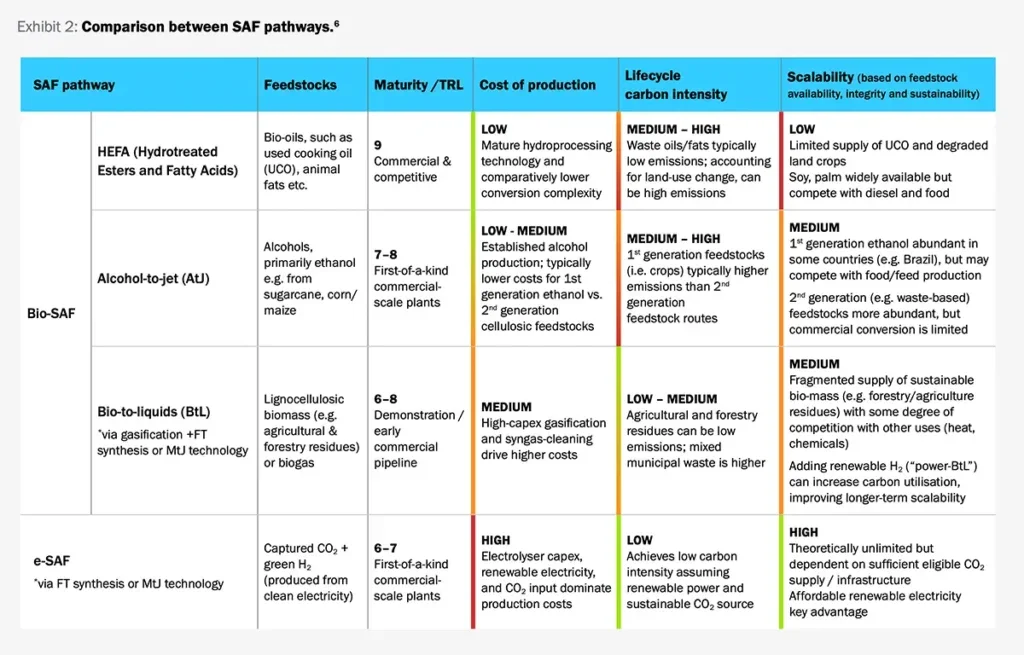
For each of these pathways, the guide explores three core questions:
- Eligibility: Does a project or strategy meet relevant regulatory and certification requirements?
- Bankability: Does it have a credible business model capable of supporting long-term investment?
- Integrity: Are its environmental and social outcomes supported by robust evidence and safeguards?
Together, these questions provide a consistent framework for assessing whether SAF opportunities can support both financial returns and credible decarbonization outcomes.
What’s inside the guide
The report includes a structured due diligence toolkit covering six key areas (see Exhibit 9):
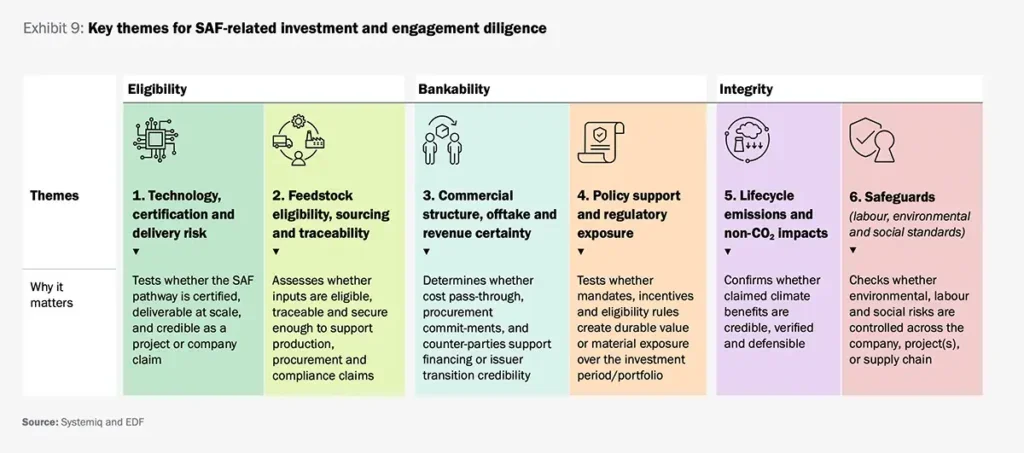
For each topic, the guide translates complex technical issues into practical questions that investors can use during screening, due diligence, stewardship and engagement processes.
The guide also explores how evolving policy frameworks are shaping the SAF market. It reviews major developments across Europe, North America and other emerging markets, helping investors understand how mandates, incentives and sustainability criteria influence project economics and future demand.
Recognizing that different capital providers have different information needs, the guide includes dedicated considerations for both project- and asset-level financing and issuer- or portfolio-level assessments. It also highlights common red flags, evidence gaps and decision points that may warrant further scrutiny, engagement or investment conditions.
Why it matters
This is not an ESG checklist. It is a decision-oriented framework designed to help financial institutions allocate capital more effectively while supporting aviation’s transition to lower-carbon fuels.
Who should read this report
Commercial banks, project finance lenders, infrastructure and private equity investors, asset owners and managers, bond investors, stewardship teams, development finance institutions and policymakers seeking to understand the key questions that should shape investment decisions across the rapidly evolving SAF landscape.
Download the report to access the full due diligence framework, which includes pathway-specific guidance, policy analysis and illustrative case studies.
Aviation’s Climate Transition
An investor due diligence guide to
SAF opportunities, risks & integrity

-
Net Zero Action AcceleratorReduce Emissions Through Sustainable Aviation Fuels
-
Sustainable Aviation Buyers AllianceAccelerating the Transition to Net Zero Aviation
-
EDF Energy ExchangeSmarter jet fuel policies and carbon markets can power cleaner aviation
Our Experts

Senior Director, Sustainable Finance