- Resources
- From mandate to bankability: Aviation’s climate transition is now an investment issue
Resources
From mandate to bankability: Aviation’s climate transition is now an investment issue
Published: October 21, 2026 by Andrew Howell and Guillaume Morauw
This post was co-authored by Angie Farrag-Thibault, EDF
Today, 2.8% of the aviation fuel supplied at EU airports is sustainable aviation fuel (SAF). By 2050, EU law will require that share to rise to 70%, with targets rising in steps along the way. Closing that gap requires the aviation industry to accelerate the pace of its transition, from a slow taxi down the runway to a proper takeoff.
New SAF plants must be built. Long-term offtake contracts must be signed for fuel that can cost considerably more than fossil jet fuel. Credible systems must be in place to verify that the climate benefits are real. And, ultimately, it all needs financing.
For investors in aviation-exposed companies, this is neither a distant 2050 problem nor a question limited to climate. Higher fuel costs, new procurement obligations, investment in production capacity and infrastructure, and exposure to different regulatory regimes can all affect margins and cash flows. Investors who assume that the industry can continue operating under anything close to business-as-usual risk mispricing both the risks and the opportunities associated with this transition.
From targets to projects: the money is starting to move
Recent developments illustrate how quickly the conversation is moving from aspirational targets towards the more concrete challenges of launching projects, sealing contracts and attracting financing.
On 22 September, the Sustainable Aviation Buyers Alliance (SABA) announced commitments from its members to purchase SAF certificates associated with Infinium Energy’s Project Atlas, a planned facility expected to produce around 100,000 tons of e-SAF annually. The agreements – which EDF helped facilitate as a co-founding member of SABA – provide the kind of long-term contracted demand that can help a first-of-a-kind project secure financing.
The next day, Uniper, a major European power and gas trader, announced an agreement to purchase 40,000 tons of e-SAF annually for more than ten years from Arcadia eFuels’ Project Endor in Vordingborg, Denmark.
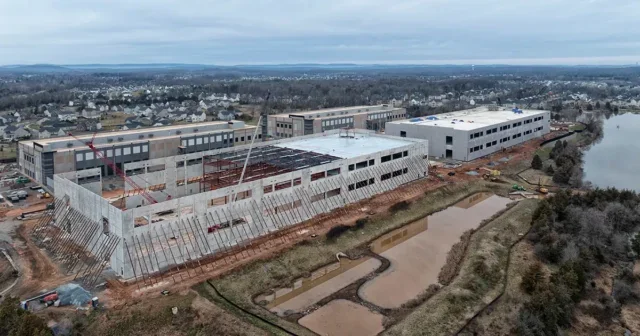
And in France, on the same day, aviation fuel supplier Q8Aviation signed a strategic cooperation agreement with Verso Energy, whose 400 MW DEZiR e-SAF project in Normandy aims for production around 2030, giving the project additional commercial visibility as it moves toward the final investment stage. Verso’s ambitions extend beyond a single facility: its broader development program, supported by Rely, encompasses seven e-fuels plants targeting more than 500,000 tonnes of SAF production annually. For perspective, that is equivalent to more than one-fifth of current global SAF production and roughly one-sixth of the approximately 3 million tonnes of annual SAF demand expected in the EU by 2030.
These are significant numbers, and they are also revealing. Long-term offtakes, corporate demand aggregation and other structures surrounding these projects are being developed precisely because commercial first-of-a-kind plants are still difficult to finance. Demand for SAF exists. The emerging question is what combination of contracts, policy support and risk allocation will turn that demand into projects that reach final investment decision and actually get built.
These deals also show why integrity and transparency can become a commercial issue. A corporate buyer of SAF certificates never physically handles the fuel; what it is purchasing is the right to claim the associated environmental benefit. The value and credibility of that claim depend on robust registries and safeguards, clear ownership of the environmental attributes, credible verification and protection against double counting.
Policy creates demand, but not certainty or bankability
Governments are developing tools to address the SAF financing gap. The EU and UK are combining SAF mandates with revenue-support mechanisms, including a €2.1 billion-plus German-Austrian-Luxembourg e-SAF auction and the UK’s guaranteed strike-price approach. The U.S. relies more heavily on production incentives and fuel-credit markets, including the 45Z Clean Fuel Production Credit, the Renewable Fuel Standard and state clean-fuel programs.
Currently, policy remains broadly supportive, but a mandate on paper is not a bankable revenue stream. Investors need to know whether support is large enough and will last long enough to sustain individual projects and corporate strategies. They also need to know whether the fuel will continue to qualify as rules evolve. Weak evidence on sourcing, lifecycle emissions or other eligibility criteria can undermine policy eligibility and, with it, anticipated revenues. Such questions around affordability, supply, technology readiness and the durability of support have now become more consequential.
From climate ambition to investment diligence: three tests for investors
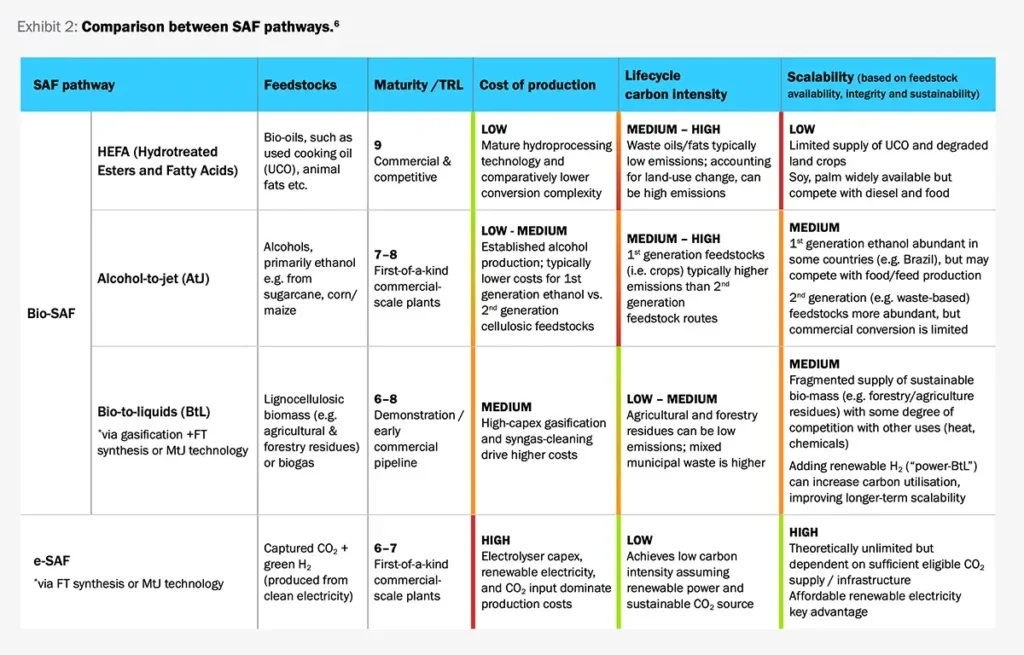
Against this backdrop, Environmental Defense Fund and Systemiq have published Aviation’s Climate Transition: An Investor Due Diligence Guide to SAF Opportunities, Risks & Integrity. This report is intended for both project and asset-level investors assessing SAF infrastructure projects, and investors and lenders to aviation-exposed corporates, assessing SAF and climate transition strategy. The guide recommends testing projects against three criteria: eligibility, bankability, and integrity.
What this means in practice for investors
The guide moves from questions to evidence, red flags and practical investor responses. The questions change depending on where investors sit, whether they are specialist infrastructure investors or more general asset managers.
Take an investor assessing an airline: they may not finance an e-SAF plant directly, but they should still understand how much of the airline’s 2030 SAF strategy depends on plants that have not yet been commissioned, how higher fuel costs could affect margins and competitiveness, how costs might be passed through to passengers, corporate travel customers or cargo clients, and whether its procurement strategy is sufficiently contracted and diversified to deliver against its targets.
Asking these questions early is not about walking away from the market. It gives investors a sharper basis for setting conditions, pricing risk and engaging with companies.
What investors told us
At an event to discuss the report last week, held on the sidelines of the Principles for Responsible Investment annual conference in Amsterdam, one message came through clearly from our discussion with investors, project developers and other market participants: financing cannot be separated from the quality and durability of the revenues behind SAF projects and strategies.
A recurring challenge for emerging SAF projects is the mismatch between the shorter commitments buyers are often willing to make and the longer-term revenue certainty investors need. We explored how longer-term airline offtake, corporate demand, contracts for difference, double-sided auctions and other risk-sharing mechanisms could help bridge that gap.
For investors assessing airlines, the conversations also highlighted the importance of looking beyond headline SAF targets. Ambition matters, but so do the details: how much fuel is procured today, what future offtake is contracted, whether companies are investing in new supply and how they are helping to build the broader market. Across both SAF project finance and airline investment, the conclusion was the same: bankability and environmental integrity must be assessed together, with robust evidence on volumes, timelines, counterparties, policy dependence and the underlying fuel pathway.
For more, see Aviation’s Climate Transition: An Investor Due Diligence Guide to SAF Opportunities, Risks & Integrity. For practical guidance on reducing emissions from air travel, see EDF’s Net Zero Action Accelerator Action Guide. For a deeper technical treatment of SAF environmental integrity, lifecycle accounting and sustainability criteria, see EDF’s High-Integrity Sustainable Aviation Fuels Handbook.
-
Actionable Insights for a Decarbonizing WorldExplore the Hub
-
Reduce Emissions From Air TravelView action guide
-
The High-Integrity Sustainable Aviation Fuels HandbookDownload PDF
Our Experts
Senior Director, Sustainable Finance