- Resources
- Five reasons every investor in oil and gas should read the OGMP 2.0 report
Resources
Five reasons every investor in oil and gas should read the OGMP 2.0 report
Published: October 26, 2026 by Andrew Howell and Andrew Baxter
A new report from a multilateral agency rarely sends people rushing to read it. But if you invest in oil and gas and want to understand the risks associated with methane emissions, the latest Oil and Gas Methane Partnership (OGMP) 2.0 annual report deserves your attention. It was quietly published earlier this month – but it deserves some fanfare.
The 2026 edition offers compelling evidence that better measurement is improving our understanding of methane emissions — and helping companies identify opportunities to reduce them. For the many investors who have encouraged companies to join OGMP 2.0 over the past few years, it also provides confirmation that the approach they have been supporting is bearing fruit. Here are five reasons to read it – and also see our slide deck, which tells this story through charts.
1. OGMP is increasingly the global reference point for methane measurement
The partnership now has 163 members operating in 90 countries who together produce 43% of global oil and gas (up from 153 members / 42% share in last year’s report). Twenty-one members are national oil companies, extending better measurement practices to state-owned producers. The number of companies reporting methane data to the partnership increased from 137 to 145.
Participation spans the gas supply chain. Of the 145 companies that submitted reports in the latest cycle, 60 are upstream operators, 51 are midstream and 34 are downstream. Producing assets, pipelines, LNG facilities and distribution networks are part of the effort.
The partnership has grown significantly, but has more room to expand, as 57% of global oil and gas production remains outside it. Investors still have a substantial opportunity to encourage further participation. And as seen below, there are good reasons to do so.
2. Membership is translating into better reporting
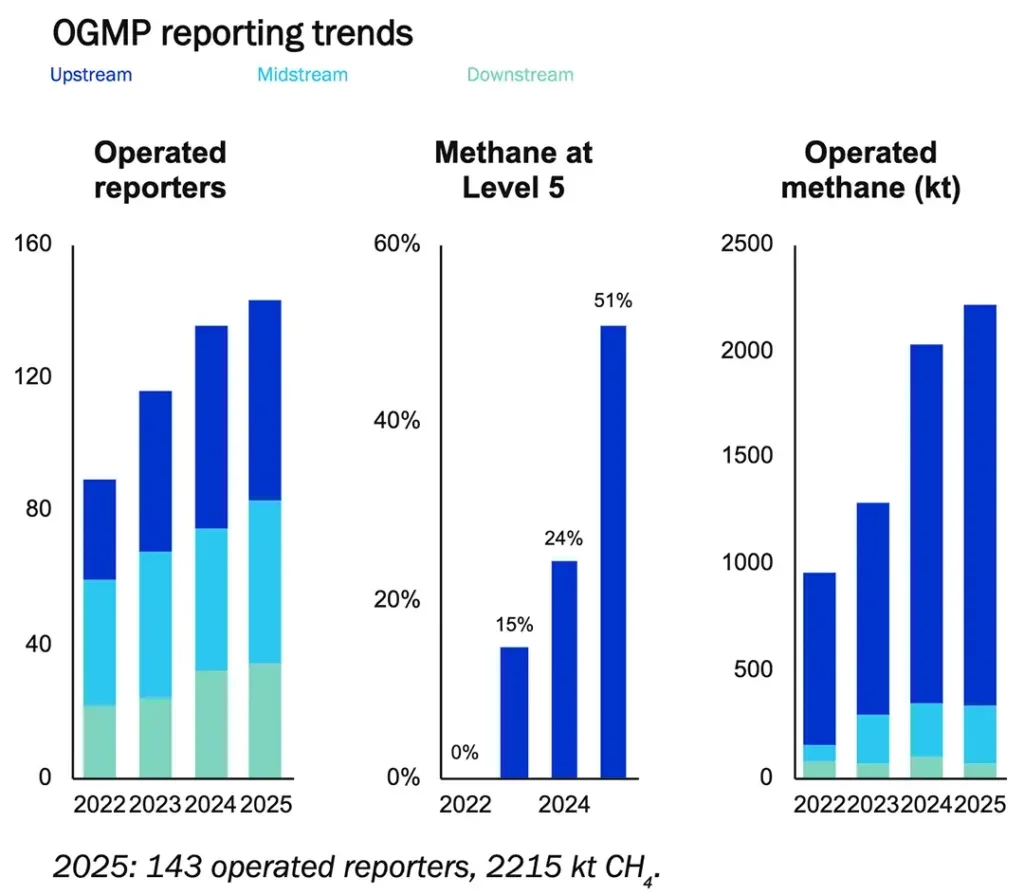
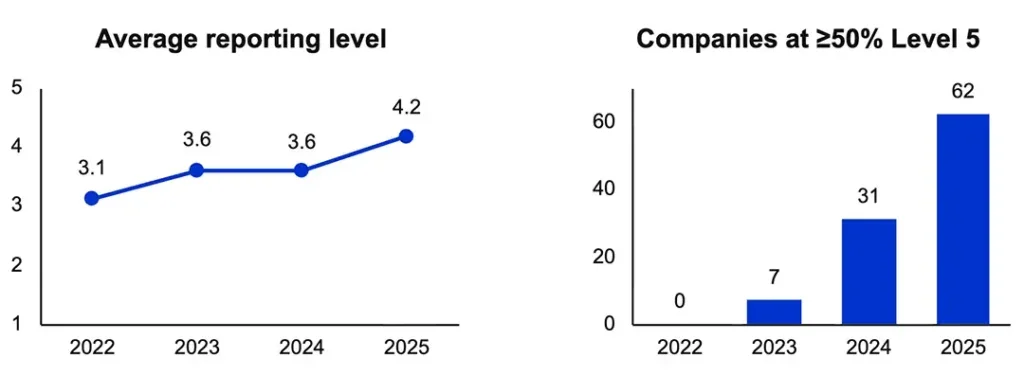
When companies join OGMP 2.0, they commit to improving how they measure and report methane emissions over time – a process we call “Leveling Up”. The latest data show substantial progress. OGMP 2.0 defines five reporting levels, reflecting increasing detail and use of measurement. Level 3 relies on generic emissions factors. Level 4 uses asset-specific data, including direct measurements, engineering calculations or process simulations. At Level 5, companies generally reconcile those source-level inventories with independent measurements of emissions from the site as a whole. This cross-check can identify emissions that might otherwise be missed.
Our analysis of this year’s company factsheets shows that the emissions-weighted average reporting level for operated assets rose from 3.6 in 2024 to 4.2 in 2025. Level 5 now covers 50.7% of reported operated methane, compared with 24.2% in 2024 and 14.6% in 2023. Levels 4 and 5 together cover 71.0% of operated methane emissions. UNEP also reports that assets at Level 5 now account for 16% of global oil and gas production.
OGMP awards Gold Standard Reporting status to companies that set a methane performance target and meet its requirements for progressing material assets to measurement-based reporting, including demonstrated attempts to reach Level 5 within the required timelines. As of the latest report, 90 companies now hold this status, compared with 64 a year ago. Newly recognized companies achieving this designation include ExxonMobil, EOG Resources, Expand Energy, APA, Coterra, Petrobras, PTTEP, QatarEnergy and Williams.
3. Level 5 reporting is revealing methane that factor-based estimates missed
An early example of Level 5 reporting was ConocoPhillips; in OGMP’s 2024 report (covering 2023 emissions), 95% of the company’s operated methane was classified at Level 5 measurement for the first time. At the same time, its reported methane inventory rose 116% (from 66,800 metric tons in 2022 to 144,300 in 2023). ConocoPhillips attributed the increase in its estimated emissions to improved data quality, particularly corrected equipment counts and classifications and expanded flare-downtime monitoring. The key point is not that the company’s methane emissions doubled; it was that emissions were being measured more accurately. That report was an early illustration of why a higher reported inventory can be welcome evidence of better measurement, rather than a reason to assume emissions management has deteriorated.
Subsequent OGMP 2.0 reports have seen other operators follow a similar path. For this year’s report, we note 45 companies whose share of operated methane reported at Level 5 increased by at least 20 percentage points compared with the previous year. The combined reported methane inventory of this cohort rose 42.1% last year, from 707,200 to 1,004,950 metric tons.
Nineteen of those 45 companies reported increases in methane emissions. The largest absolute increase came from Diversified Energy, whose inventory rose 607%, from 21,000 to 148,500 metric tons, followed by EOG Resources (up 538%, from 11,400 to 72,800). These two companies accounted for more than half of the group’s net increase, but other substantial increases came from Expand Energy, Occidental and Crescent Energy.
A few caveats to note. While improved measurement is the most likely explanation for the higher methane at many companies as they reach Level 5, other factors such as acquisitions, disposals and changing reporting boundaries could also play a role. (For example, EOG completed its Encino acquisition in August 2025, while the merger creating Expand from Chesapeake and Southwestern closed in October 2024. Both events may have affected reported methane.) Engagement may be required to clarify the dynamics underlying specific movements.
Also, movement into Level 5 did not always coincide with higher inventories: this year, for example, Woodside reported a 36.1% decline and INPEX a 23.2% decline while substantially expanding Level 5 coverage.
In the report, UNEP notes that reconciliation can revise estimates upward or downward, rather than producing a universal pattern. For investors, the report provides an opportunity to ask companies to explain how inventory changes reflect previously uncounted methane, portfolio changes, production or mitigation.
4. Sustained Level 5 reporting is shining a light on credible methane reductions
With this report, we now have a larger cohort of companies who have been reporting substantial Level 5 coverage across successive years. Devon is an example: the company reported 100% of operated methane at Level 5 in 2024 and 99.1% in 2025, while its reported inventory fell 10.3%, from 99,500 to 89,300 metric tons. That decline followed a 309% increase in the previous year, when it reached broad Level 5 coverage. TotalEnergies, Shell and Repsol also reported declines, of 24.4%, 15.9% and 29.7%, respectively, with at least 75% of operated methane at Level 5 in both years.
Overall, the eight upstream reporters with at least 75% of operated methane at Level 5 in both 2024 and 2025 saw their combined reported methane inventory fall 7.4% (four reported declines, one was unchanged and three reported increases, including ConocoPhillips, up 1.9%, and Jonah Energy, up 25.6%).
These declines are encouraging evidence of real mitigation taking place. To be sure, they still require some scrutiny: as noted above, changes in ownership, production or reporting boundaries could still be playing a role in reported tons. Investors should seek a clear explanation of those effects and evidence that operational reductions are sustained. But where appropriate, investors should take the opportunity to send positive feedback to companies for achieving real world mitigation.
How reported methane changed

5. Better measurement is guiding specific methane reductions
This year’s report also provides concrete examples of actions companies have been taking on what measurements reveal. Two examples:
- At KazMunayGas (KMG), site-level measurement identified a high-emitting flare pit associated with a likely ignition-system malfunction. Repairs produced an estimated 7,000-metric-ton methane reduction in 2025; UNEP reports no subsequent satellite detections at that location.
- At TotalEnergies, measurement identified unexpectedly high methane emissions from a furnace used to heat crude oil. Process changes removed the need for that heating, allowing the furnace to be taken out of service and reducing estimated emissions by approximately 100 kilograms per hour.
- Meanwhile ExxonMobil has highlighted its achievement of Gold Standard reporting, one year ahead of schedule. The company noted that its Vantage operations center and COMET platform monitor more than 22,000 wells around the clock, helping teams identify potential methane emissions issues and respond more rapidly.
Such cases show how better information can guide specific operating decisions. For investors, that opens a more concrete discussion about repair costs, gas recovered, deployment across other facilities and measurements confirming sustained reductions. These project-level estimates should be distinguished from changes in a company’s total annual inventory.
Why this matters: better quality methane emission data helps companies face the future
Better measurement is foundational to companies’ plans and actions to mitigate emissions now. But credible methane emission data is becoming increasingly important when it comes to regulatory preparedness and market access into the future. The EU Methane Regulation recognises independently verified OGMP 2.0 Level 5 reporting as one route to demonstrating that imported oil and gas meet its methane monitoring, reporting and verification requirements. Although proposed delays to these obligations and methane-intensity reporting create uncertainty over timing, OGMP 2.0 remains an important framework for suppliers preparing for compliance and demonstrating credible methane performance.
Greater scrutiny of methane emissions is a global trend. Launched in 2023 by major Japanese and South Korean LNG buyers, the Coalition for LNG Emission Abatement toward Net-zero (CLEAN) is a voluntary public-private partnership to track and reduce methane emissions across global supply chains. Japan and Korea’s largest LNG importers survey their suppliers on methane, ingest OGMP 2.0 data supplied to them by IMEO and publish the results annually. Voluntary initiatives around purchasing near-zero methane emission gas are gaining momentum, and participation will be underpinned again by companies having OGMP 2.0 Level 5 data to share.
Shareholder engagement is delivering results
Finally, the report sheds light on the impact of years of engagement and shareholder proposals from investors asking for more reliable methane disclosure. Our review identified at least 15 shareholder proposals at 14 US-listed oil and gas companies during the 2022–2025 proxy seasons, seeking more reliable methane measurement and reporting, and at times explicitly citing OGMP 2.0.
Of these 15 proposals, 12 were withdrawn, two won majority support and one was voted down. Several of the withdrawals followed company commitments or constructive dialogue. Six of the 14 companies subsequently joined OGMP 2.0: APA, Chevron, Coterra, EOG Resources, ExxonMobil and Williams. Although membership cannot be attributed solely to shareholder proposals, these outcomes illustrate how investor engagement can help advance measurement-based methane reporting.
The clear conclusion, based on this latest data, is that investors who encouraged companies to join OGMP have helped champion a credible approach to methane management. The new evidence supports continuing that work: bring more companies into the framework, accelerate coverage of operated and non-operated assets, and seek clear explanations of what measurements reveal and what action follows. Better data is making investor engagement more concrete and more impactful.
-
Actionable Insights for a Decarbonizing WorldExplore the Hub
-
OGMP 2.0 2026 Report: From measurement to mitigation, better methane data is enabling actionDownload report
-
OGMP 2.0 Methane DatasetLearn more
Our Experts

Senior Director, Sustainable Finance

Associate Vice President, Business and Energy Transition