- Resources
- Climate risk transmission across banks and insurers: Opportunities for risk mitigation and improved resilience
Resources
Climate risk transmission across banks and insurers: Opportunities for risk mitigation and improved resilience
Published: October 27, 2026 by Kate Stein, Guillaume Morauw and Andrew Howell
This post was co-authored by David Carlin, Reuben Wambui, Simon Messenger, D.A. Carlin & Company.
Banks and insurers finance and protect many of the same homes, businesses and infrastructure, leaving them exposed to the same climate shocks. Yet they often assess these risks using different information, assumptions and time horizons.
Insurers can reprice or withdraw coverage annually, while bank loans may run for decades and assume that insurance will remain available. When insurance coverage becomes unaffordable or disappears, the risk does not. It can shift onto banks, borrowers and public budgets, contributing to falling asset values, credit losses and reduced investment in resilience.
The self-reinforcing feedback loop between insurance retreat and credit tightening

This report from Environmental Defense Fund, developed in partnership with D.A. Carlin & Company, examines how climate risk moves between banks and insurers, what this means for institutional, financial-system and societal resilience; and how closer collaboration between the two sectors could strengthen risk management, reduce underlying risks and unlock investment in adaptation.
Key insights
- Supervisory frameworks for climate risk have advanced since 2020, though progress has been uneven across geographies, and implementation of climate risk into market practices has been slower. Day-to-day credit and underwriting practices still lag, while supervision remains largely separated along sectoral lines.
- The transmission of insurance stress into credit risk is already visible in recent data, but credit decisions continue to rely on assumptions about insurance availability made at loan origination that are inconsistently updated afterwards.
- Banks and insurers have complementary capabilities. Insurers hold detailed hazard and loss information, while banks have the long-term relationships and financing capacity needed to support adaptation. But better information alone is not enough: more accurate risk assessment can accelerate market withdrawal unless accompanied by investment in risk reduction and consideration of who bears residual losses.
- The most meaningful improvements depend on joint action. Common definitions of resilience, targeted asset-level data and damage functions, routine verification of insurance coverage, and methods for capital rules to recognize resilient assets cannot be developed by individual institutions alone.
A practical agenda for action
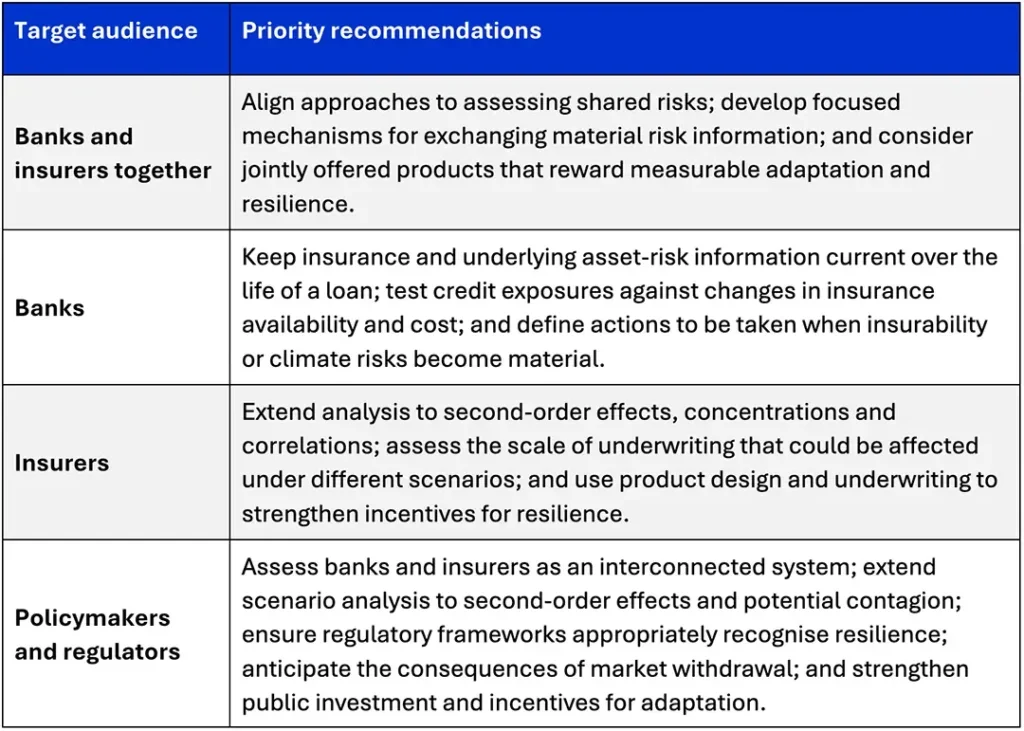
The objective is not to sustain lending or insurance everywhere at any cost. It is to build a shared understanding of risk that supports better decisions about adaptation, financing and the allocation of residual losses.
By improving how banks and insurers identify and manage their shared exposures, the financial system can move beyond transferring climate risk between balance sheets and play a more effective role in reducing it, with the resilience of people and the real economy at its centre.
Download the full report to explore the evidence, findings and recommendations.
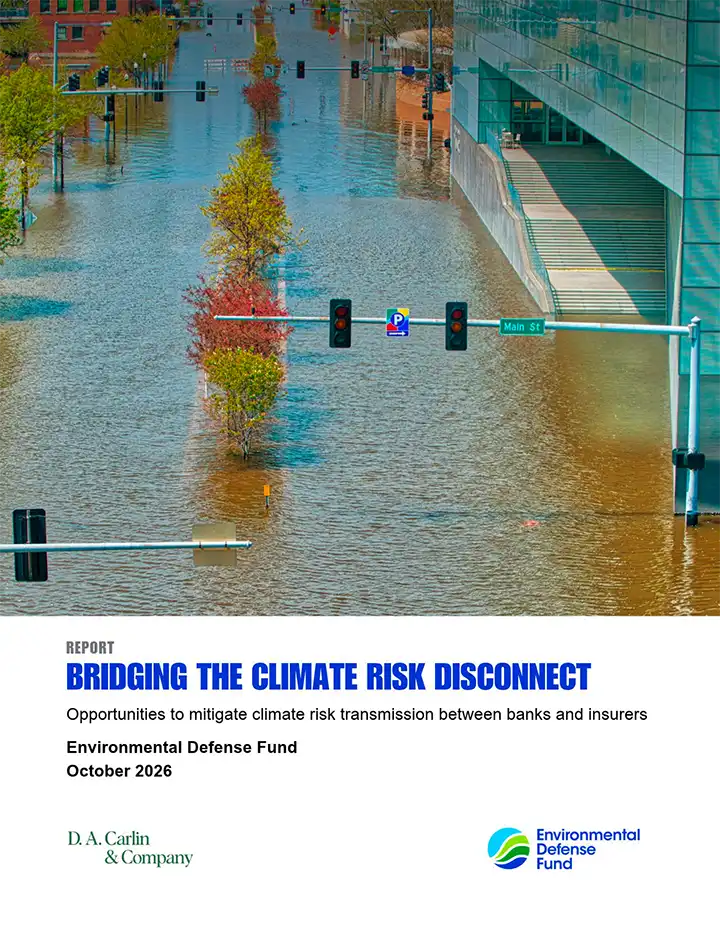
Bridging the Climate Risk Disconnect
Opportunities to mitigate climate risk transmission between banks and insurers.

-
Bridging the Climate Risk DisconnectRegister
Nov. 5 at 10am ET, 3pm GMT
-
Driving decarbonization through insurance innovationRead blog
-
Actionable Insights for a Decarbonizing WorldExplore the Hub
-
Sign up to receive future research updates on insuranceSign up for updates
Our Experts

Director, Insurance


Senior Director, Sustainable Finance