- Resources
- The origin story of the “Insure-stein”: What benchmarking the world's largest insurers tells us about climate leadership
Resources
The origin story of the “Insure-stein”: What benchmarking the world's largest insurers tells us about climate leadership
Published: October 29, 2026 by EDF Staff
This post was authored by Amany Darkaoui, Fulbright scholar
Insurers sit at the center of the climate challenge in ways few other financial actors do. They price the risk of a warming world, pay out when it materializes, and through their underwriting and investment decisions, they shape what gets built and what can or cannot be financed. If any industry is structurally equipped to lead on climate, it should be this one.
As part of a five-month research project, Fulbright scholar Amany Darkaoui assessed 20 of the largest global property and casualty insurers across two separate benchmarks to answer a deceptively simple question: where do insurers stand on climate transition and adaptation? One benchmark measured policies to enable the climate transition while the other measured efforts to encourage adaptation and resilience. So, based on this analysis, who is leading the climate race?
The answer: within the assessment, no single firm leads across every dimension. And, compiling a full picture is complicated because disclosures vary widely from region to region, and insurer to insurer.
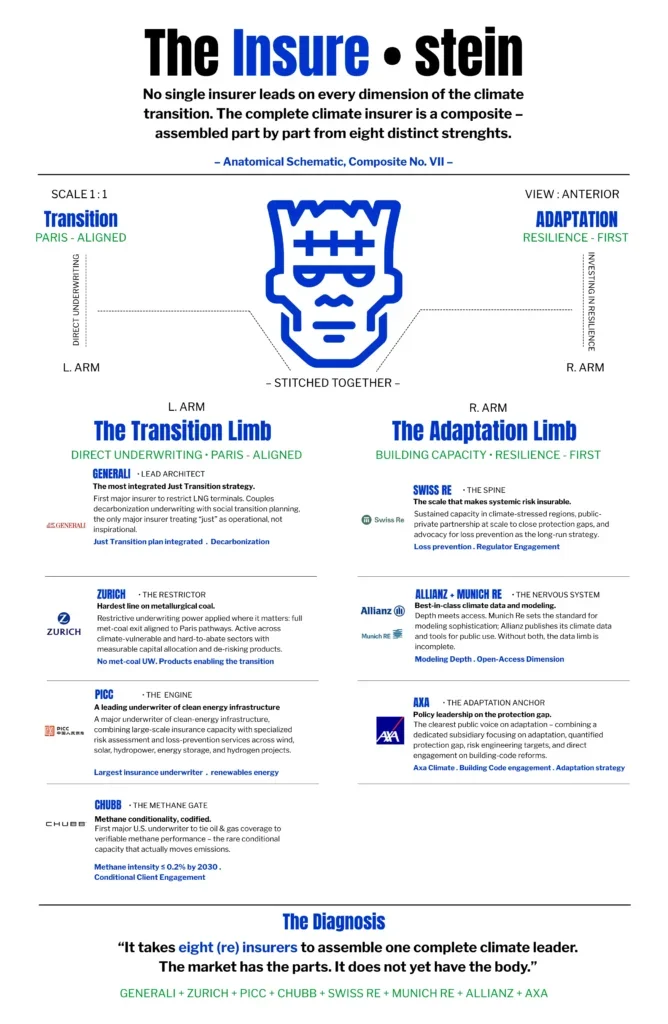
The assessment did not identify a single insurer that excelled across every dimension. Instead, leadership was distributed and had to be assembled from the strongest practices across companies and regions: transition policies from one insurer, adaptation analytics from another, resilience engagement from a third. In that sense, the current model of leadership is less a single champion than a Frankenstein-like composite — let’s call it an “Insure-stein”— built from the best pieces of the industry.
The fragmented nature of progress
Insurers are not starting from the same place. Some have built sophisticated public architectures around climate governance, with quantified underwriting restrictions, detailed emissions targets, and extensive disclosure frameworks. Others disclose comparatively little, or frame climate primarily through catastrophe exposure rather than transition strategy. This is a reality that shapes everything that follows.
In the scoring, the seven European insurers occupied the seven highest positions in both benchmarks, raising a question this analysis cannot fully resolve: how much of that leadership reflects genuine climate ambition, and how much reflects Europe’s more demanding disclosure regime?
Just Transition is mostly a paragraph when it could be a portfolio. Most insurers in the sample reference Just Transition in some form. Very few treat it as operational. But the more striking finding is not what is missing. It is what is already there, unrecognized. The instruments to deliver Just Transition exist on insurance balance sheets, and simply are not labeled as such.
Some insurers underpromise and overdeliver. Chinese insurers and US mutuals, in very different ways, show patterns of operational climate delivery that exceed their public commitments, raising questions about whether disclosure and target-based coalitions and alliances are filtering out exactly the actors they need.
Introducing the “Insure-stein”
These findings point toward a bigger question. Given that every insurer leads on something and no insurer leads on everything, what would it take to build the complete climate insurer? The answer required a little imagination. We call it the Insure-stein. Rather than being a monster, this creature represents some of the best and most climate-progressive initiatives the insurance industry has to offer, on both adaptation and on the energy transition.
For the full benchmark methodology, findings, and the Insure-stein synthesis, read the brief.